


The classic push-up is mastered: 3 sets of 12 clean reps, full range. Now what? More reps means stalling. You saw that with the 100 push-ups challenge. To keep progressing, harden the variation, not the number.
Here are the variations that matter, from easiest to hardest, with the target muscle and the mistake to avoid for each.
The test to pick your level
Pick the hardest variation that allows 8 to 12 full, clean reps. Below 8: too hard, drop down a level. When 3 sets of 12 quality reps become easy: move up to the next level.
Golden rule, the same as everywhere: a light full movement always beats a heavy incomplete load. 6 full reps of a hard variation build more than 40 ugly reps of an easy one.
(For my part, I'm between the classic and archer level right now: hands under my pecs, widening them progressively toward archer. One variable at a time, and at the first sign of shoulder irritation, stop hardening.)
1. Incline push-ups, to start or warm up
Hands on a table, a counter, or a stable chair (check it doesn't slide). Body straight from heels to head, same bracing as the classic push-up.
Typical mistake: glutes rising as fatigue hits. Squeeze them from the start.

2. Knee push-ups, the real intermediate step
Knees on the floor, body straight from knees to head, no glutes in the air, no arched back. Lower until your chest is near the floor.
Typical mistake: sagging in the middle. If your back arches, the version is still too hard — go back to incline, no shame.

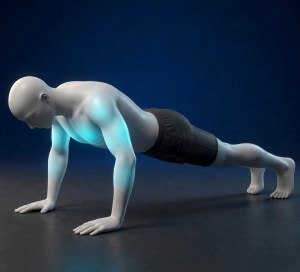
3. Classic push-ups, the standard
Hands shoulder-width, fingers spread. Lower keeping elbows at about 45 degrees from your body. Chest near the floor, push back up to straight arms.
This is the variation to master before everything else: 3 sets of 12 clean reps is the entry ticket for what comes next.

4. Diamond push-ups, for the triceps
Hands together under your chest, thumbs and index fingers forming a triangle. Lower keeping elbows close to your body, push back up hard.
What changes: the effort shifts to the back of your arms. Excellent when your pecs are no longer the limiting factor.
Typical mistake: elbows flaring out in a T — it bangs your shoulders. Keep them tucked, even if it means fewer reps.

5. Feet elevated, for the shoulders
Feet on a chair or a bench, hands on the floor. The higher your feet, the more the effort shifts to your shoulders (front delts).
Typical mistake: your back arching under fatigue. Squeeze your glutes and abs like a plank — because that's what it is, a moving one.
Start low (one stair step), raise the height only when the range stays full.

6. Archer push-ups, the gateway to the one-arm push-up
Hands very wide. One arm pushes hard, the other stays almost straight and guides the movement. Alternate the working side each set.
What changes: almost all the weight goes through one arm — the logical progression toward the one-arm push-up.
Typical mistake: hips twisting to cheat. Keep your pelvis straight, facing the floor. If twisting is unavoidable, the variation is too hard for now.

How to use them in a workout
Two to three times a week, never two days in a row. Four sets per workout, one to two minutes of rest between sets.
And yes, you can mix variations in the same workout — it's even a good idea. My format: 2 sets on the hard variation (the 8-to-12 test one), then 2 sets of classic.
Why? The first 2 sets give the main stimulus: that's where effort is maximal and the muscle gets the signal to progress. After that, the hard variation wouldn't go down cleanly anymore — rather than forcing it with bad form, switch to classic: it lets you accumulate clean volume, quality reps that add work without breaking technique. Two slightly different angles, more complete development, and it avoids monotony.
The 4th set as a drop set: as soon as form breaks down on classic, switch immediately to the easy variation (incline or knees), no rest, and continue to clean failure. That's the set that empties the tank.
One important point: keep the same hard variation from one workout to the next for several weeks. It's your benchmark — if the numbers go up, you're progressing. The classic sets are volume: they don't need comparing, just doing cleanly.
And log your numbers — tracking progress is how you measure it.
Changing variation — that's progress: not more reps, harder reps. The mastered classic push-up isn't an end, it's the beginning. Next: the variation just above, the one where the twelfth rep still burns.
Leave a Reply