


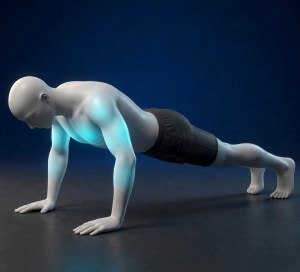
Push-ups push. You also need to pull. Without pulling, shoulders roll forward, your back stays weak, and your posture suffers. Table rows are bodyweight pulling — the direct counterpart to push-ups, no bar, no gym.
The setup
A sturdy table that won't tip over. Test it before getting under. Lie on your back, chest under the edge. Grab the edge with both hands, shoulder-width. Wrists hurting? Grab the side of the table instead of the top edge: wrists stay straight and the pain goes away. That's what I do — sensitive wrists demand it. Body straight from heels to head: glutes off the floor, back not arched.
My cue: sternum at the table edge. That's the position that gives full range of motion without straining your shoulders.
Pull until your chest touches the edge. Lower back down with control, arms almost straight at the bottom, without harshly locking your elbows.
What it works: your back (lats between your shoulder blades), rear delts, and biceps. Everything push-ups don't hit.
Pick your level
The same test as for push-ups: the hardest variation that allows 8 to 12 full, clean reps.
- Knees bent, feet on the floor : the gentle version to start. Feet slipping? Bend your knees, problem solved.
- Legs straight : the standard. Body straight, heels on the floor, glutes tight.
- Feet elevated : feet on a low chair, body more inclined, the hard version.
When 3 sets of 12 clean reps go down: move up a level. The rule never changes: a full easy movement beats a harder incomplete one.
My progress looks like this — the opposite of what you'd expect: at first, legs straight, but incomplete movement: my chest never touched the edge. Now, knees bent, and my sternum touches the table edge on every rep. My back works much harder. Proof, once again: full range at an easier level always beats a half-done hard level.
Typical mistakes
Hips sagging. Your body must stay a plank from start to finish. If your glutes drop toward the floor, the variation is too hard. Drop down a level, no shame.
Half reps. Half-pulling is stealing half the benefit. Chest to the edge on every rep, arms almost straight at the bottom. Full range, always.
Pulling with your neck. Keep your head in line with your back. If your chin clears the edge before your chest, your neck is doing the work, not your back.
In your workout
Table rows are the counterpart to push-ups: both in the same workout means push/pull balance. Same format: 2 to 3 times a week, never two days in a row.
A simple sequence that works well: a set of push-ups, one to two minutes of rest, a set of rows. And so on. Your back works while your chest recovers. The workout moves along with no dead time.
And log your numbers, as always: tracking progress is how you measure it.
Pushing without pulling is like building a house with one wall. Table rows are the second wall — and all they need is a table.
Leave a Reply