
Type: Push · Difficulty: Intermediate
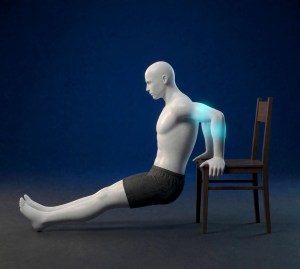
Muscles worked: back of the arms (triceps), chest (pectorals) and front of the shoulders (front deltoids).
Chair dips work the back of the arms like no other bodyweight exercise can without equipment. Hands placed behind you on a chair, the body lowers and rises on arm strength alone. They complement push-ups, which push in front of the body, by pushing under the body instead. Do them once or twice a week, in a push session or a full session.
The position


The steps
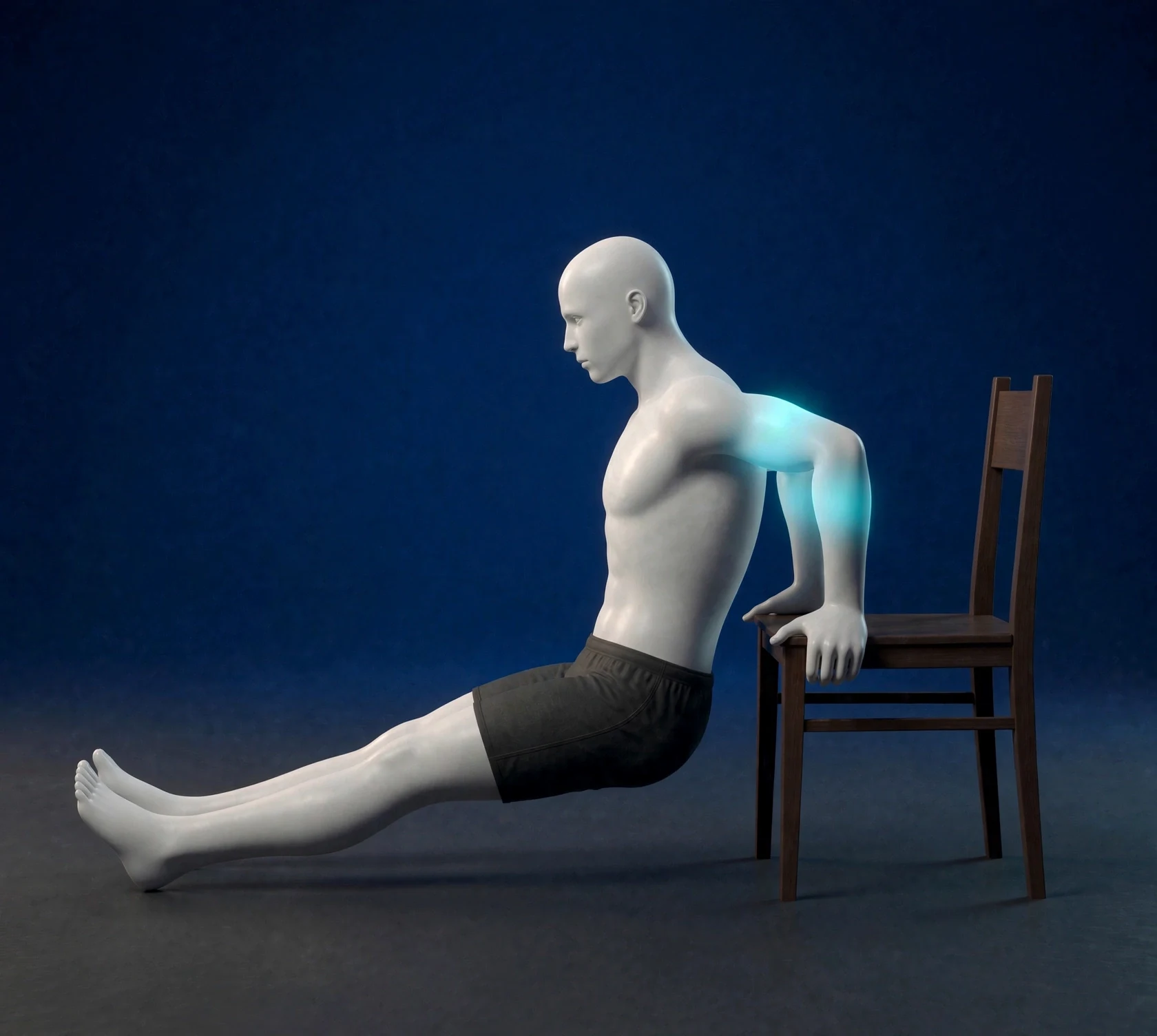
- Sit on the front edge of a sturdy chair, hands on either side of your hips, fingers pointing forward, gripping the edge of the seat firmly.
- Walk your feet forward and slide your hips off the chair. Legs are straight, heels on the floor, back close to the chair.
- Lower yourself slowly by bending the elbows, which point backward, until the upper arms are roughly parallel to the floor. Your hips move down toward the floor without touching it.
- Keep your back close to the chair through the whole descent, torso upright and shoulders down, away from your ears.
- Push through your palms to rise back to straight arms, without snapping the elbows locked at the top.
Why this exercise
- The back of the arms makes up most of your arm size. For stronger, fuller arms, that is where the work counts most.
- The push goes downward, at an angle push-ups do not cover. Together, the two exercises cover every upper-body push.
- It is the strength to lift yourself out of a chair, an armchair or off the floor by pressing on your arms. A movement you use every day.
Common mistakes
- Going too low: when the shoulders drop below the elbows, the front of the shoulder takes needless strain. Stop the descent when the upper arms are parallel to the floor.
- Drifting away from the chair: the further your hips move from it, the more the shoulders strain and the less the arms work. Stay close to the chair.
- Helping with the legs: the heels are a support, not the engine. If the thighs push, the arms stop doing the work.
- Shoulders rising to the ears: keep them down and back through the whole movement.
- A chair that moves: fix this mistake before the others. A stable chair, its back against a wall if needed.
Adjust the difficulty
- Easier: bend your knees, feet flat on the floor closer to the chair. The load on the arms drops. You can also use a sturdy table instead of the chair: the higher support makes the descent shallower and the exercise easier. Start with 3 sets of 6 to 8 reps.
- Harder: straighten the legs fully, slow the descent to three seconds, or pause for one second at the bottom.
- The pace: 3 sets of 8 to 12 reps, with 60 to 90 seconds of rest between sets.