Type: Core · Difficulty: Beginner
Muscles worked: sides of the core (obliques), shoulders (deltoids) and glutes.
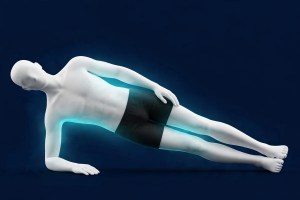
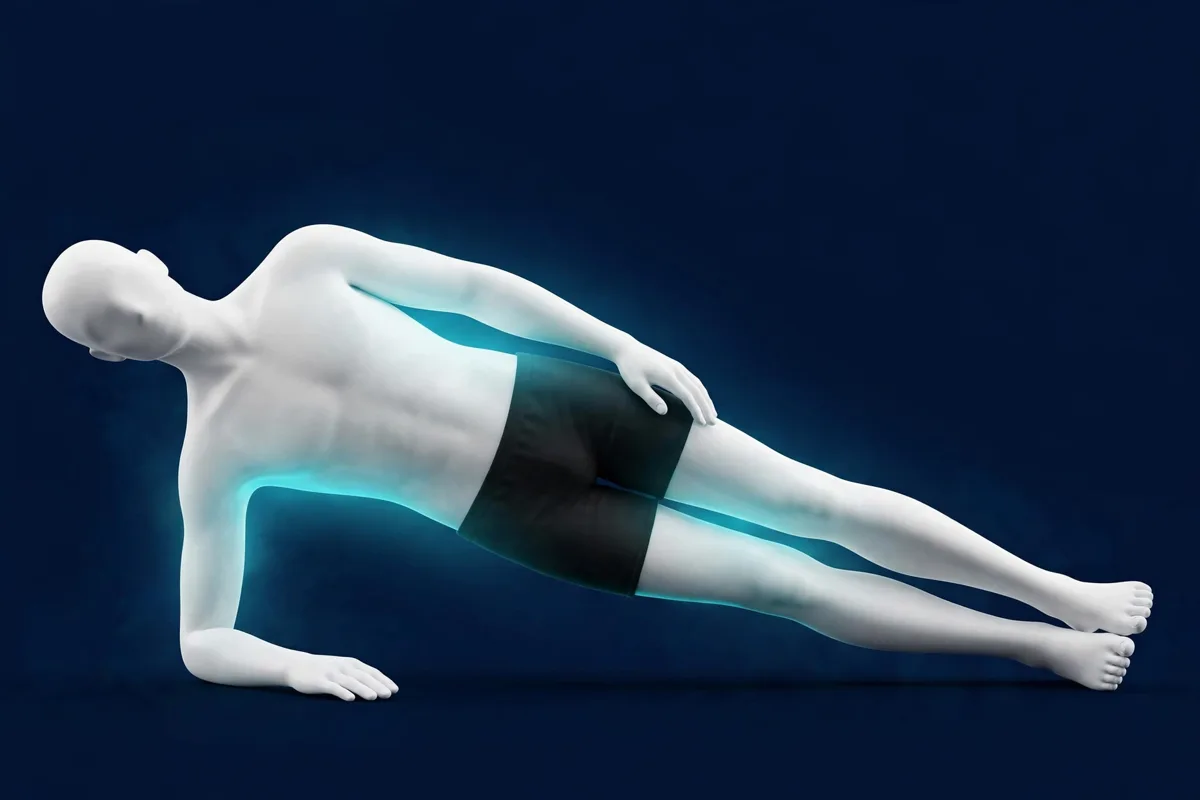
The side plank: supported on one forearm, your body held in a straight line. It works the sides of your core, the ones the front plank barely covers, and the balance that comes with it.
The position

The steps
- Lie on your side, legs straight, one foot on top of the other.
- Place your elbow right under your shoulder and lean on your forearm, resting on the floor pointing forward.
- Brace your abs and glutes, then lift your hips until your body forms a straight line from head to feet.
- Rest your other hand on your hip or along your body.
- Hold the position while breathing normally, then switch sides.
Why this exercise
- The sides of the core are the forgotten part of front planking. They are what keep your pelvis from tipping when you carry a load on one side: a grocery bag, a child, a suitcase.
- It corrects imbalances between the left and right sides. Each side works on its own, the stronger one cannot compensate for the other.
- It builds pelvis and hip stability, useful for lunges and every single-leg exercise.
- It completes the front plank. Together, they cover the core in every direction.
Common mistakes
- Hips dropping toward the floor: push them up and keep your glutes squeezed.
- Your body rolling forward or backward: keep your shoulders and hips lined up, as if you were between two walls.
- Elbow too far from the shoulder: it should be right under it, or the shoulder strains for nothing.
- Holding your breath: breathe normally through the whole hold.
Adjust the difficulty
- Easier: bend your knees and support yourself on your knees instead of your feet, or keep your top foot on the floor in front of you for help.
- Harder: slowly lift your top leg, or hold the position longer.
- Benchmark: start with holds of 15 to 20 seconds per side. When 3 holds of 30 seconds per side go cleanly, try a harder version.
- The pace: several short, clean holds beat one long hold with dropping hips.
In case of pain
Stop the exercise as soon as you feel pain. Muscle fatigue is normal, pain is not. If the pain comes back or persists, see a health professional.