Type: Core · Difficulty: Beginner
Muscles worked: lower back (lumbar muscles), glutes, abs and shoulders.
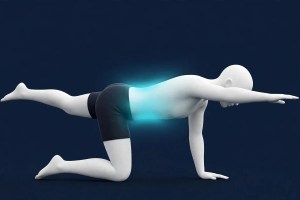
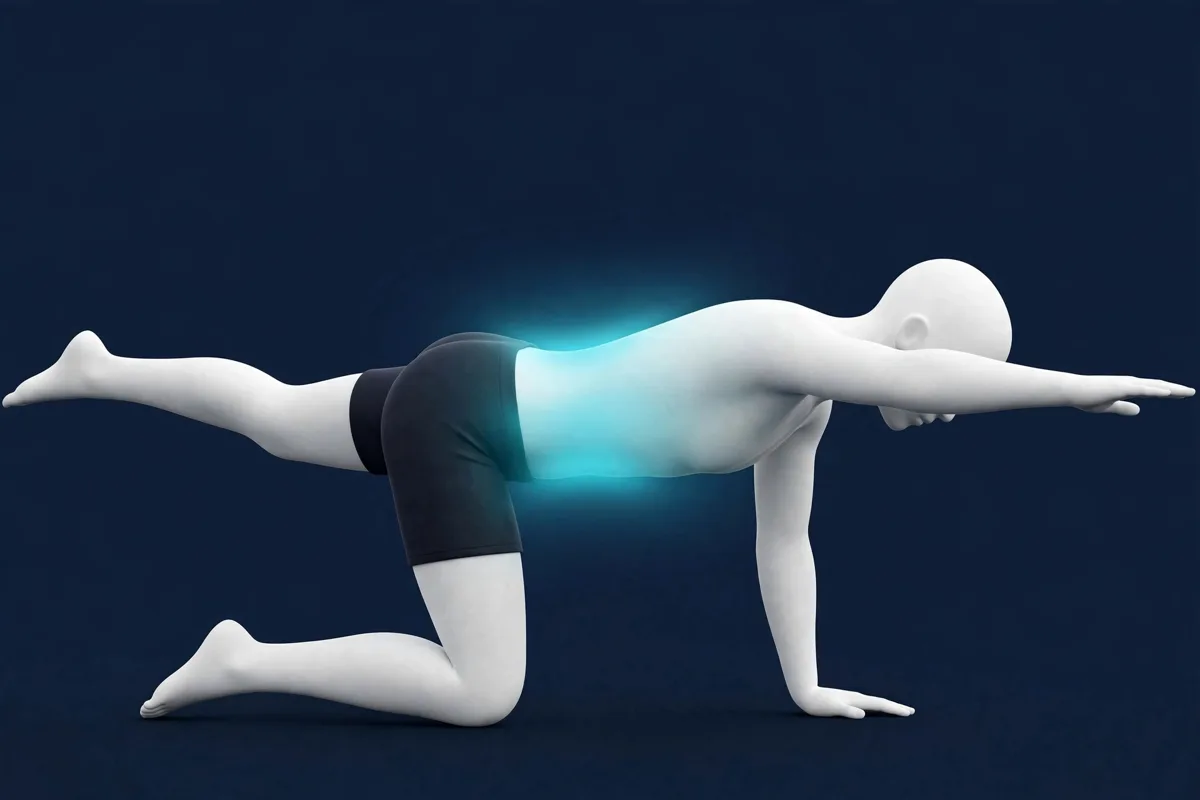
On all fours, you reach one arm forward and the opposite leg back, without your back moving or your hips rotating. It is a stability exercise: all the work is in letting nothing move. Slow, no load, with no equipment at all.
The position


The steps
- Get on all fours, hands under your shoulders and knees under your hips, hip width apart.
- Set your back flat, neither arched nor rounded, and keep your eyes on the floor so your neck stays in line with your back. Tighten your glutes and your abs.
- Slowly reach your right arm forward, at shoulder height, and your left leg back, at hip height, at the same time.
- Hold the position for two or three seconds. Your hips must stay level, as if a glass of water resting on your lower back must not spill.
- Return slowly to all fours, without dropping the movement, then do the same on the other side.
Why this exercise
- It strengthens the lower back and glutes with no load and no repeated bending of the back. For a back that calls for caution, it is one of the safest ways to make it work.
- It trains stability in the opposite-limb pattern, the same pattern as walking and running: the core holds while the opposite arm and leg move.
- It corrects imbalances between sides: one side at a time, and there is no compensating with the strong side without it showing, the hips rotate right away.
- It completes the Dead bug, its mirror image: lying on your back for one, on all fours for the other, the same work of a core that holds while the limbs move.
Common mistakes
- Lifting the leg too high: the back arches as soon as the leg goes above hip height. The leg goes far back, not high.
- Letting your hips rotate or open toward the lifted leg: keep both hips facing the floor, the glass of water must not fall.
- Moving fast, with a swing: pause in the extended position. Without the pause, momentum does the work, not your muscles.
- Lifting your head to look ahead: your neck breaks line and your back follows. Keep your eyes on the floor, slightly in front of your hands.
- Placing your hands and knees too wide or too narrow: hands under your shoulders, knees under your hips, that stable base is what makes everything else possible.
Adjust the difficulty
- Easier: one limb at a time. Extend only the leg, sliding it along the floor before lifting it, or only the arm. Add the second limb when the first no longer moves your hips.
- Harder: extend the pause in the extended position to five or ten seconds, or bring your elbow and knee toward each other under your belly between extensions, without ever putting your hand or knee down.
- The pace: 3 sets of 6 to 8 repetitions per side, slowly, with one minute of rest between sets. End the set as soon as your hips rotate or your back arches.
In case of pain
Stop the exercise as soon as you feel pain. Muscle fatigue is normal, pain is not. If the pain comes back or persists, see a health professional.